The Ed-Tech industry experienced a phenomenal transformation this year, marked by the emergence of AI-powered tools, and a handful of other platforms are aligning with the Phygital revolution.
Why Is It Considered A Game-Changer?
The tech invention made in the education field gives shape to practices which broaden the scope of education and training in India.
This results in opening the doors for students scattered across rural India, and they get equal opportunities.
Such a framework also empowers educators to renew their efforts with a fresh tech-fueled approach and not be bound to classrooms.
In the write-up, I have summed up 10 innovative practices in our country which are powered by tech, due to which education has become easily within reach, while classrooms have also been modernized.
1. GenAI Tutors: Edtech News India Latest
Many leading Ed-Tech platforms now enable AI models that function as personalized mentors. Students benefit from tailored growth experiences, with platforms like Vedantu and PhysicsWallah introducing mentors who utilize AI frameworks.
As such, learners can access them 24×7 to pick up the preparation and to spruce up learning.
2. Digital Documentation That Is Fully Valid And Traceable:
We now have access to a blockchain framework, which ensures full security of our academic documents, and no unauthorized access can be made. Beyond this, such documents are easily verifiable.

Such a provision is a boon for study abroad aspirants, and one is spared from standing in long queues for the purpose. Such a framework is called Digilocker.
3. “Phygital” Learning Centre: Tech News Updates in India
Parents prefer offline learning while youth rally for online mode, and both ways have some give and takes, and to overcome such a bunch of drawbacks, Phygital Learning Centres throng the urban landscape of India.
As is self-explanatory, this mode blends the offline learning benefits with the online version and its amenities.
Now, a student can link to a classroom where a qualified teacher from a reputed institution in a big city would explain complex formulas and subject matter on a big screen with a real-time feel.
At the same time, local trainers are there to contact and discuss your doubts.
4. Proliferation of Neurodivergent Friendly Technology: Edtech News India Latest
There are learners with neurodivergent needs, and thanks to the propellers of education technology, who have been thoughtful for such people.
We now have gadgets, software and applications that are useful for those with dyslexia, autism, and dyscalculia.
To name a few, we have sensory safe interfaces, an exclusive range of fonts such as OpenDyslexic, the AAC has been unrolled too, which is Augmentative and Alternative Communication, and is best for autism and speech-impaired people.
5. Growth of Skills Passports: Tech News Updates in India
Candidates now reflect their academic and professional worth through Skills Passports, which are digital in nature and can easily be adapted.
All praises to the blockchain technology, which authenticates this and furnishes us with the central repository for safekeeping of our academic data.
This is akin to Digilocker or any other digital documentation solution that reflects our abilities and can be accessed from anywhere.
6. Enchanting Transition: No chalkboards, but Cloud Boards
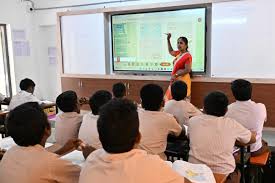
Classrooms witness a towering upgrade with chalkboards being thrown out of Indian classrooms, and cloud boards have been fitted in their place.
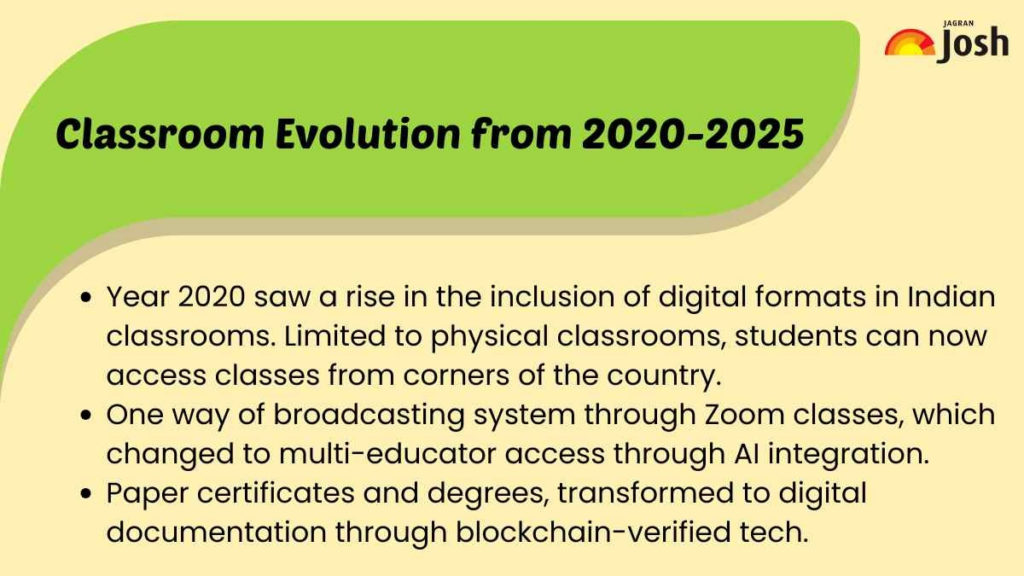
Here, by “The Cloud Board”, we mean a Cloud-Based Interactive Panel which functions like a command centre, similar to smart classrooms.
In many upscale academic institutions in India, such devices are a treat to notice, which is a large device that connects a conventional classroom to dozens of digital resources.
Undoubtedly, it can unlock many advantages for educators who are empowered to teach pupils without any equipment or laptops.
All learners have to do is establish a link with the cloud-based documents by logging into their accounts from any place.
7. Yuva AI for All: This program supports learners and students from all backgrounds.
Learners from diverse backgrounds find relief and help through it. In India, the Ministry of Electronics and Information Technology (Meity) rolled out it, which pursues the goal of helping 10 million Indians become AI literate.
A candidate does not need to be computer literate or have any knowledge of AI, and through the intricate labyrinths of AI, their comprehension is aided.
8. SOAR (Skilling for AI Readiness):
By 2025, SOAR will serve as India’s guide for implementing AI in classrooms.
This initiative aimed to integrate AI technology into Indian classrooms and was led by the Ministry of Skills Development and Entrepreneurship (MSDE).
Under this, the AI, initially, was unveiled as a subject for young students from class 6th to class 12th.
As such, the AI framework is now explained to young minds as a problem-solving tool, rather than a subject.
9. Diksha 2.0: Tech News Updates in India
As the title suggests, 2 is an improved version of the platform, while the earlier one, Diksha, was a mammoth reserve for PDFs and videos.
Such is a big tech push towards “One Nation, One Digital Platform” under the auspices of NDEAR (National Digital Education Architecture).
In the scenario, the outstanding aspects are personalized learning in an adaptive environment, which also entails ASL and other sign languages, audiobooks, and virtual reality laboratories.
Teachers in the present age have also been evolving fast as they happily bid adieu to conventional teaching practices and embrace premium tech.
As for the regular AI tools, they need commands to direct the function, while for Agentic AI, the scenario is entirely different, as the latter is designed to handle much of the paperwork and can easily be programmed to meet the exclusive requirements of the learners.
In short, Agentic AI is virtually the teacher’s aide, which takes off the burden from their shoulders, and teachers can easily focus on their practice and nurturing pupils in the academic arena.
The weak areas of students can easily be stressed upon for problem solving, and teachers would not feel stressed with responsibilities like grading, scheduling, and the overall management, and they would not be drained out too.
Such have been the trends that dominated the EdTech scenario in 2025 in India, and as we usher into a new year, things appear pretty promising.
We shall keep you posted here.