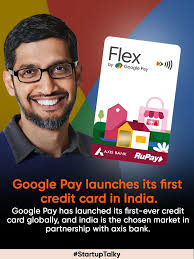
Thinking about our ease, Google Pay has come up with a credit card option on the RuPay network to ensure a flexible mode of payment.
Customers can link it with their UPI accounts for retail payments, while Axis Bank has Google’s back.
As a cherry on top, it ensures cashbacks and rewards which are swift, and users would be saved from having to wait for the month or once the
credit cycle terminates.
“Where we have innovated is the way you can use your rewards. You earn rewards instantly on every transaction, and you can immediately use them on the very next transaction,” said Sharath Bulusu, senior director and product manager at Google.
Popularity Skyrockets: Fintech News Latest Today in India
RuPay-UPI’s new offering has drawn mass attention for its convenience and widespread reach, promising increased credit and rewards, much like a credit card.
Can Mastercard and Visa be embedded with UPI?
A million-dollar question, but a disheartening answer is a big NO. In the case of RuPay and UPI, the National Payments Corporation of India controls them.
Mr. Bulusu maintains that UPI’s success has empowered Google Pay and has fueled its innovation for customers to redeem rewards for the next payment. Fintech news is just a tab away.
Competition Fueled: Fintech news latest
PhonePe, which enjoys a reputation of being the biggest UPI service, had launched the RuPay credit card in June and was supported by HDFC Bank in the endeavour.
In July, it joined hands with SBI Cards to roll out credit cards on Visa and RuPay circuits. Fintech news is right here.

Paytm Carried the Baton Too: Tech news updates in India.
It is interesting to note that the pioneer of such digital monetisation started the journey of credit cards in 2019 and was helped by Citibank, while in 2021, HDFC rushed towards it.
In the wake of this, as for SBI, it opened its account as its credit card banking partner. Fintech news latest for the right decision at the right time.

Other Heavyweights In The Ring:
Cred and Supermoney are the other prominent apps which presented credit cards as viable to be used with UPI.
Mr Bulusu ruled out that Google Pay would be an early bird and would not follow others’ trail in the field.
“RuPay has been successful for other players; they’ve been successful for their objective. For someone, the objective might have been user growth, for someone else it might have been revenue, for someone else it might have been something else,” Mr Bulusu shared.
He concluded that credit access in India is limited to only one in five customers; addressing this gap could significantly expand the market.
Unrolls A Scenario Which Isn’t Rigid: Tech news updates in India
The aspect that widely motivates customers is that of flexibility, and customers are obliged to cover their monthly charge in easy EMIs, and that too, in a period of six to nine months.
Tech news updates in India to uncover tech truth.
There are numerous consumer apps that offer cashbacks or reward points from 5% to 10% for payments that pass through platforms, while on partner apps and through websites, too. Such cashbacks are just from 3% to 5%.
“We figured out that flexibility in repayments and simplicity in repayments matter to users, but it is hard to build, and we wanted to solve it before launching the card,” Bulusu said.
Cashback Is Thin On Other Payments:
When it comes to all other payments, cashback hovers from 1% to 1.5% from the card, which includes scan and pay during UPI transactions.
Ace Credit Card: Fintech News Updates in India
In association with Axis Bank, Google Pay also puts forth the Ace Credit card, which uses the Visa network.
Nevertheless, such a card is not a co-branded service in the exact translation of the RBI’s guidelines.